The Lucky Pun: How Chinese Homophones Shape Gifts, Festivals, and Everyday Life
Why Chinese Is a Language Built for Puns
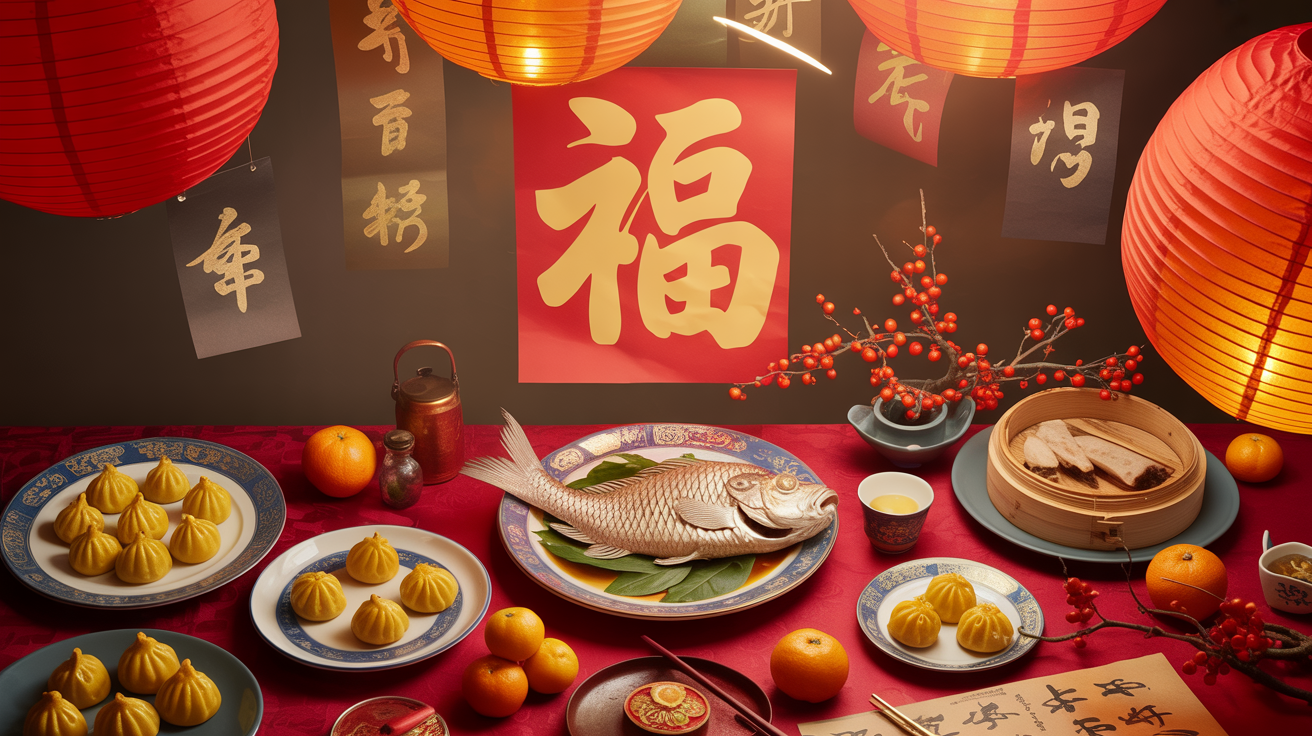
Walk into a Chinese home during the Lunar New Year and you'll notice something curious: a red paper character pasted upside down on the front door. Ask your host why, and they'll smile and say, "Because fortune has arrived." The character is 福 (fú), meaning "luck" or "fortune" — and it's deliberately inverted because the word for "upside down" (倒, dào) sounds exactly like the word for "to arrive" (到, dào). Flip the character, and you've turned a decoration into a wish.
Welcome to the world of 谐音 (xiéyīn) — the Chinese art of the homophonic pun. It's one of the most quietly powerful forces in Chinese culture, shaping what people eat, what they give as gifts, which numbers they avoid, and even how they navigate the internet. And once you understand it, you'll never look at a bowl of fish soup the same way again.
Mandarin Chinese has a remarkably compact phonetic inventory — only around 400 distinct syllables, compared to thousands in English. Add in four tones, and you still end up with a language where an enormous number of words share the same or very similar sounds. This isn't a flaw; it's a feature that Chinese culture has embraced for millennia.
The result is a linguistic landscape where meaning and sound are in constant, creative conversation. A gift isn't just an object — it's a word, and that word might sound like something wonderful or something terrible. A number isn't just a quantity — it's a sound, and that sound might echo life or death. For speakers of Chinese, this awareness is second nature. For outsiders, it opens a fascinating window into how deeply language shapes culture.
The New Year Table: A Feast of Fortunate Sounds
Nowhere is xiéyīn more alive than at the Chinese New Year dinner table, where nearly every dish has been chosen not just for its flavor, but for what its name sounds like.
Fish (鱼, yú) is perhaps the most iconic example. The word yú is a perfect homophone for 余 (yú), meaning "surplus" or "abundance." This gives rise to one of the most beloved New Year greetings: 年年有余 (nián nián yǒu yú) — "may there be surplus year after year." Serve a whole fish, and you're not just feeding your guests; you're wishing them prosperity. Crucially, the fish is often left partially uneaten — because finishing it would mean using up all your surplus.
Rice cakes (年糕, nián gāo) carry a similar blessing. The word gāo sounds like 高 (gāo), meaning "high" or "tall," evoking the expression 年年高升 (nián nián gāoshēng) — "to rise higher every year." Eating rice cake is a bite-sized wish for career advancement and growing fortune.
Dumplings (饺子, jiǎozi), especially beloved in northern China, are eaten at midnight as the new year begins. Their name echoes 交子 (jiāo zi), where jiāo means "to exchange" and zi refers to the midnight hour — the precise moment of transition. Their crescent shape also resembles ancient gold ingots, doubling down on the wealth symbolism.
Sweet glutinous rice balls (汤圆, tāngyuán), eaten at the Lantern Festival that closes the New Year season, sound like 团圆 (tuányuán) — "reunion." Round, soft, and sweet, they are the edible embodiment of family togetherness.
The Gifts You Should Never Give
If xiéyīn can bless, it can also curse — and this is where the art becomes genuinely important for anyone navigating Chinese social life.
Never give a clock. This is perhaps the most famous gift taboo in Chinese culture. The phrase "to give a clock" — 送钟 (sòng zhōng) — is phonetically identical to 送终 (sòng zhōng), which means "to attend someone's funeral" or "to see someone off to their death." Presenting a clock to an elderly relative isn't just thoughtless; it's a declaration that you're waiting for them to die. In 2015, a British minister caused a minor diplomatic incident by gifting a pocket watch to a Taiwanese official — a reminder that these taboos have real-world consequences.
Pears are for parting. The word for pear, 梨 (lí), sounds like 离 (lí), meaning "to separate" or "to leave." Sharing a pear — 分梨 (fēn lí) — sounds exactly like 分离 (fēnlí), "to part ways." Couples and close friends avoid splitting pears for this reason.
Umbrellas scatter relationships. The word 伞 (sǎn) echoes 散 (sàn), meaning "to disperse" or "to break apart." Gifting an umbrella suggests you want the relationship to dissolve — not the message most people intend.
Shoes walk away. The word 鞋 (xié) sounds like 邪 (xié), meaning "evil" or "wicked." Giving shoes implies you're sending someone down a bad path.
Four is the number of death. The number 四 (sì) sounds nearly identical to 死 (sǐ), "to die." As a result, the number four is avoided in gifts, addresses, phone numbers, and building floors across China and much of the Chinese diaspora. Many apartment buildings in Chinese cities — and in Chinatowns worldwide — simply skip the fourth floor entirely.
Lucky Numbers and Auspicious Sounds
The flip side of these taboos is a set of numbers and words that are actively sought out for their fortunate sounds.
Eight (八, bā) is the luckiest number in Chinese culture because it sounds like 发 (fā), as in 发财 (fācái) — "to get rich." The 2008 Beijing Olympics opening ceremony began at 8:08 PM on August 8th for exactly this reason. Phone numbers, license plates, and apartment numbers containing multiple eights command premium prices.
Six (六, liù) sounds like 流 (liú), evoking smooth flow and progress — hence the expression 六六大顺 (liù liù dà shùn), "everything goes smoothly." And nine (九, jiǔ) sounds like 久 (jiǔ), meaning "long-lasting" — making it a popular choice for wedding dates and anniversary gifts.
Tangerines (桔, jú) are displayed and gifted during New Year because jú sounds like 吉 (jí), meaning "auspicious" or "lucky." You'll find them piled high in Chinese homes and businesses every January and February.
Puns in the Digital Age and the Diaspora
Xiéyīn is far from a relic of the past. In China's heavily monitored internet, homophonic wordplay has become a tool of creative resistance. Users substitute sensitive words with homophones to slip past automated censors — a linguistic cat-and-mouse game that has produced an entire vocabulary of coded speech.
In diaspora communities, puns serve as cultural glue. Chinese restaurant names around the world are often elaborate puns — in-jokes for those who speak the language. A London restaurant called "Dim Sum Duck" carries the Chinese name 点都得 (diǎn dōu dé), a Cantonese pun meaning "anything goes." Cross-language puns blending Chinese and English have become a hallmark of younger diaspora humor, a way of holding two cultures at once.
For those learning about Chinese culture, xiéyīn is more than a linguistic curiosity. It's a reminder that in Chinese thought, words have weight — their sounds carry intention, and intention shapes reality. The next time someone serves you fish at a Chinese dinner, know that they're not just feeding you. They're wishing you a year of abundance, one homophone at a time.